
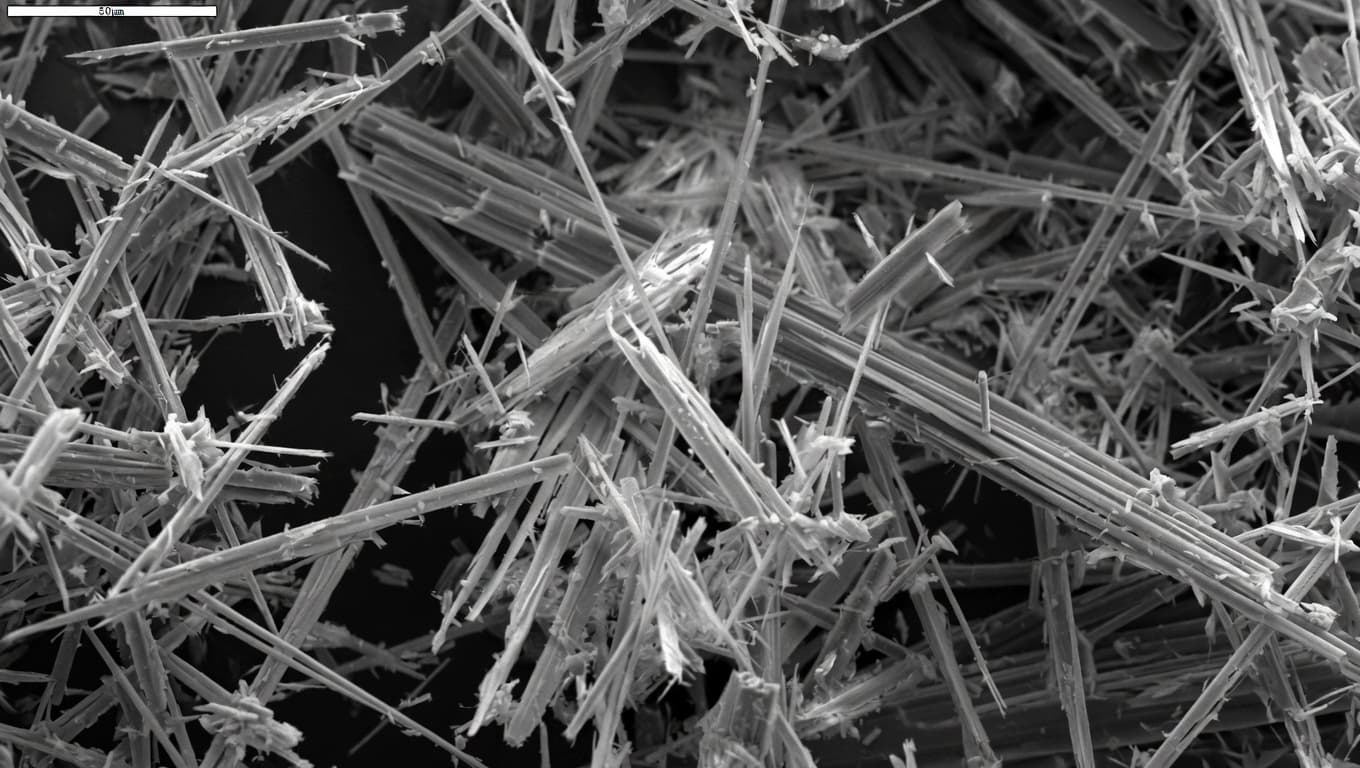
What is asbestos?
Asbestos is a group of naturally occurring fibrous silicate minerals. Asbestos fibres are extremely fine - a single fibre can be up to 1,000 times thinner than a human hair. That property is exactly what makes asbestos dangerous: the fine fibres travel with the air you breathe deep into the lungs.
Asbestos is practically indestructible: it withstands heat, chemical attack and mechanical wear. Because of these properties it was used extensively in the construction industry in insulation, fillers, adhesives, roofing felt, pipe insulation and floor coverings.
The use of asbestos was banned in Finland in 1994. It is estimated that some 200,000-300,000 buildings in Finland still contain asbestos-bearing materials.
Types of asbestos
Asbestos minerals fall into two main groups: serpentine asbestos and amphibole asbestos. The types most commonly encountered in Finland are the following:
Chrysotile (white asbestos)
The most common type, accounting for roughly 95 % of all asbestos used. Found in fillers, cement products, seals and textiles. It belongs to the serpentine group.
Amosite (brown asbestos)
The second most common type. Used above all in thermal insulation, pipe insulation and building boards. An amphibole asbestos, more dangerous than chrysotile.
Crocidolite (blue asbestos)
The most dangerous type. Its thin, straight fibres penetrate deep into lung tissue. Used in pipe insulation and sprayed insulation. It carries the highest risk of mesothelioma.
Anthophyllite
A type mined in Finland itself (the Paakkila mine in Tuusniemi). Used particularly in Finnish building materials such as fillers and paints.
Tremolite and actinolite are also known types of asbestos. They appear more rarely in building materials, but they can turn up as impurities among other minerals.
The health risks of asbestos
Asbestos is only dangerous to people when asbestos fibres are released into the air. Intact, undisturbed asbestos material does not have to be removed, but during demolition work the release of fibres is unavoidable.
Exposure to asbestos can cause serious illnesses whose symptoms typically appear only after a delay of 10 to 50 years. The most significant diseases caused by asbestos are the following:
- Asbestosis - scarring of the connective tissue of the lungs, which permanently impairs lung function.
- Lung cancer - exposure to asbestos multiplies the risk of lung cancer, particularly among smokers.
- Mesothelioma - cancer of the pleura or the peritoneum, for which asbestos is the only known cause.
- Pleural plaques - thickening of the pleura, which restricts the expansion of the lungs.
According to the World Health Organization, there is no safe level of exposure to asbestos. That is why proper protection during asbestos work and an asbestos survey before renovation are so important.
What does asbestos look like and how do you recognise it?
Asbestos cannot be reliably identified by appearance alone. A material can look entirely asbestos-free even when it contains asbestos fibres. The risk is best judged from the year of construction, the material and where it was used: floor coverings, fillers, mortars, adhesives, roofing felt, pipe insulation and asbestos cement boards installed before 1994 are all worth checking before renovation.
Typical warning signs include a grey fibrous backing on vinyl flooring, black or dark grey bitumen adhesive, old Minerit, Eternit and Luja boards, asbestos paper wrapped around pipes, and wall and ceiling fillers from the 1960s to the 1980s. A definite answer comes only from an asbestos sample or an asbestos survey, where the material is analysed in a laboratory.
Where is asbestos found in buildings?
Asbestos was used widely in Finnish building materials from the 1920s until 1994, and most heavily of all between the 1960s and the 1980s. Asbestos may be found in, among other things:
Asbestos cannot be identified by eye. The only certain way to establish whether a material contains asbestos is a laboratory analysis. That is why an asbestos survey is essential before renovating an older building.
Asbestos board, asbestos paper, adhesive and other asbestos materials
Below are the most common building materials a survey looks at for asbestos, together with the known product brands and the years they were in use. The source is research by the Finnish Institute of Occupational Health. Remember: asbestos cannot be identified by eye - only a laboratory analysis gives certainty.
Interior wall and ceiling boards
Plasterboard and chipboard contain no asbestos. Perforated acoustic boards are the ones that typically do - the most common brands being Luja, Nordia and Paraset (use ended in the late 1970s). Asbestos-bearing Luja board was also used to line garages and the bathrooms of blocks of flats with sheet-metal walls. Asbestos-free acoustic boards include Armstrong, Isle, Perorit, Silens and Haltex.
Roofing boards (external roof)
The most common asbestos-bearing roofing board is Vartti (used until 1988). Others are Minerit, Särmä, Sifer and Paanu. Roofing materials were often bonded with an asbestos-bearing bitumen adhesive, the most common brand being Pikipoika (also used as a paint; use ended in 1988). Icopal bitumen roofs still contained asbestos in the 1980s.
Ventilation ducts
The most common asbestos-bearing ventilation duct is a light grey, square pressed cement pipe with rounded corners, sold under the Minerit or Mika brands. Use ended in 1976 at the latest.
Fire protection boards
Asbestos-bearing fire protection board is found around or above the stove in an old sauna and behind old electrical distribution boards. Use ended in the 1970s at the latest.
Floor materials
Poured plastic bathroom floors from 1954 to 1974 contained asbestos. Flexible vinyl flooring (a thin PVC surface over a light grey compound that snaps when bent) is the most common asbestos-bearing floor covering, dating from 1970 to 1985. Asbestos-bearing vinyl tiles usually measure 250×250 mm, but they were also supplied exceptionally in a 300×300 mm size. Size alone therefore does not prove a tile is asbestos-free - 300×300 mm tiles (Hovi, Kimara and Finntile, for example) are usually asbestos-free, but only a laboratory analysis gives certainty. The "black adhesive" under the tiles almost always contains asbestos. The black bitumen adhesive under mosaic parquet may also contain asbestos.
Fillers
Asbestos-bearing Vetonit filler may have been used on walls between 1960 and 1974 (on concrete walls only). In floor fillers, asbestos occurs only in the 1950s magnesium-compound and sawdust-concrete floors.
Tiles and tile adhesives
In Finland, asbestos-bearing tile adhesives under the Pukkila and Valke S brands were used during the 1960s and 1970s.
Pipe insulation
In older properties, pipes and hot water tanks are often wrapped in asbestos-bearing insulation: a grey, easily dusting powder beneath white plaster and a glass fibre mesh, or asbestos paper (corrugated board wrapped around the pipe). Glass wool and rock wool contain no asbestos.
Wallpaper
Wallpaper and wallpaper paste are in practice asbestos-free in Finland (Finnish Institute of Occupational Health).
Asbestos legislation in Finland
The use of asbestos in Finland is governed by several acts and decrees. The most important of them are:
- The Act on Certain Requirements Concerning Asbestos Removal Work (684/2015) - governs the licensing of asbestos removal work and the competence requirements for removal workers.
- The Government Decree on the Safety of Asbestos Work (798/2015) - governs the protection of workers during asbestos work.
- The Occupational Safety and Health Act (738/2002) - the general foundation of workplace safety, which also applies to asbestos work.
- The EU Asbestos Directive (2009/148/EC) - sets the minimum requirements for preventing exposure to asbestos.
The law requires whoever commissions the work to have an asbestos survey carried out before any demolition or repair work in every property built or renovated before 1994. Asbestos removal work may only be carried out by an authorised asbestos removal company.
The history of asbestos in Finland
The first manufacture of asbestos products begins in Finland.
The use of asbestos spreads through the construction industry. Asbestos cement products, pipe insulation and fillers reach the market.
The peak years of asbestos use. Finland consumes as much as 10,000 tonnes of asbestos a year. Almost any building material may contain asbestos.
The use of sprayed asbestos is banned in Finland.
The use of asbestos is significantly restricted.
Asbestos is banned outright in Finland.
The EU bans all use of asbestos in its member states.
The Act on Certain Requirements Concerning Asbestos Removal Work (684/2015) enters into force - asbestos removal work becomes subject to licensing and removal workers must hold a competence certificate.
The new EU Asbestos Directive (2023/2668) tightens the limit values for occupational exposure to asbestos.